Press-On Lash Quality Control: What Wholesale Buyers Should Check
Begin a buyer quality review with a defined specification and an identifiable approved reference. Compare visible product, configuration, packaging and revision records against that scope, and record unresolved differences before bulk confirmation. A checklist organizes buyer decisions; it is not evidence that a particular test or certification has been completed.
In this guide
- Quality Control Starts with a Defined Specification
- Define the Reference Before Checking Consistency
- Buyer Check Area 1: Product Appearance
- Buyer Check Area 2: Construction and Configuration
- Buyer Check Area 3: Packaging
- Buyer Check Area 4: Documentation and Change Control
- Questions to Ask Before Bulk Confirmation
- A Practical Buyer QC Checklist
- Separate Product Review from Supporting Documentation
Quality Control Starts with a Defined Specification
A vague 'high quality' request is not a specification
Translate a general preference into identifiable requirements and questions. Without a defined reference, different contacts may apply different expectations to the same visible sample.
Separate product, packaging and commercial requirements
Record what is being reviewed in each area. A buyer quality checklist must not be read as automatic acceptance of packaging artwork or confirmation of commercial terms.
Define the Reference Before Checking Consistency
Keep a sample approval record
Record the style reference, sample ID and revision, review date, reviewer and reference photos. Confirm the length layout, curl, fiber diameter, band dimensions, adhesive configuration, left/right pairing and tray presentation against the specification.
Record the disposition as approved, revise or hold. Log open changes, who owns each change and the next sample revision. Before bulk confirmation, identify the approved physical sample and written specification by version.
Product brief
Use the current agreed description of the selected product, format and configuration. Mark proposed changes clearly rather than comparing against an outdated direction.
Approved sample/reference
Use the accepted sample identifier, agreed scope and exceptions as QC inputs.
Packaging reference
Check against the accepted artwork and pack version; exclude temporary packaging and unapproved mockups.
Revision/version record
Use the current revision identifier and retain superseded versions for traceability.
For sample acceptance, revision and sign-off steps, use the sample evaluation guide.
Buyer Check Area 1: Product Appearance
Style direction and visible arrangement
Compare the visible product with the agreed style reference and arrangement. Describe observations in terms that the project contact can locate and discuss.
Visible consistency against approved reference
Note visible differences and connect them to the specific reference used. Do not generalize a single observation into a claim about all products or future orders.
Project-specific criteria only
Apply only the criteria agreed for the selected project. This guide does not introduce an inspection standard, sampling rule or numerical acceptance limit.
Buyer Check Area 2: Construction and Configuration
Confirm what is actually specified
Separate observable features from information that requires documents or clarification. Do not fill an unspecified construction detail with an assumption based on appearance.
Pack configuration
Compare confirmed contents, arrangement and the identified product reference. Record missing information and differences for discussion before approval.
Do not infer unverified material/adhesive claims
A visible check does not establish composition, adhesive ingredients or suitability. Keep unsupported statements out of the checklist conclusions and any resulting marketing copy.
Buyer Check Area 3: Packaging
Correct artwork/version
Check the visible wording and layout against the accepted file. Make sure a revised artwork has not been confused with an earlier approval.
Product-to-pack fit
Review the product and pack as the agreed configuration. If the reviewed example does not resolve fit, record the remaining question and next confirmation step.
Visible labeling against approved artwork
Compare the reviewed label with the buyer-approved information. This is a version comparison, not a declaration that every market requirement has been satisfied.
Buyer Check Area 4: Documentation and Change Control
Revision record
Tie comments and requested changes to the relevant version. Keep the response and final decision together so later discussions use the same record.
Approved reference
Identify the accepted product and packaging references before discussing consistency. Approval should state what was reviewed rather than imply acceptance of unlisted claims.
Open deviations and confirmation
List differences that remain unresolved and request a written decision. Do not silently treat a deviation as acceptable because another part of the project was approved.
Separate Product Review from Supporting Documentation
Product review: compare what was agreed
Review visual consistency, specified length and curl direction, arrangement and configuration, tray presentation, packaging and artwork against the approved reference. Record observed differences and their locations. Agree any acceptance criteria with the project contact; do not derive a numerical tolerance or inspection standard from a sample photograph.
Supporting documentation: map each record to its scope
Documentation availability and scope may vary by product, formulation and destination market. Ask which records apply to the selected product and what they actually cover.
- SDS / Safety Data Sheet: documentation is available; confirm the product or formulation it identifies and the relevant version.
- SGS CPSR / safety assessment: documentation is available with mapped scope. Check that the selected product and proposed use fall within that scope; do not extend an assessment to every product.
- Formulation-related documentation: where applicable, confirm which formulation and component the record concerns. A lash appearance check cannot establish formulation identity.
- FDA-related documentation: documentation is available, with scope review required. Review the specific record and applicability before using any related wording; its availability is not product approval or certification.
- Other applicable records: identify what the intended market and selected configuration require, and request the relevant record rather than assuming one common file set covers the range.
Keep a buyer documentation register
For each applicable record, retain its title, version or date, product/formulation reference, stated scope and outstanding question. Record the responsible contact and review status. Keep this register separate from sample revision notes, then link both to the approved product reference. An available document does not automatically resolve every market or label requirement.
Use quality and product verification to discuss the evidence scope, connect approvals through the OEM development process and request records for the specified project.
Questions to Ask Before Bulk Confirmation
What exactly is the approved reference?
Ask for the product, packaging and artwork versions that define the agreed scope. Confirm that later changes have been reviewed.
Which criteria are measurable/defined?
Identify the agreed criteria and how the project will discuss them. Where a requirement is vague, request clarification instead of inventing a test or limit.
Which claims have evidence?
Review each proposed factual claim against relevant support for the selected product. An illustration or buyer checklist is not certification or performance evidence.
Which items are project-specific?
Confirm requirements and arrangements for the actual order scope. Do not copy assumptions from another product, sample or earlier quotation.
A Practical Buyer QC Checklist
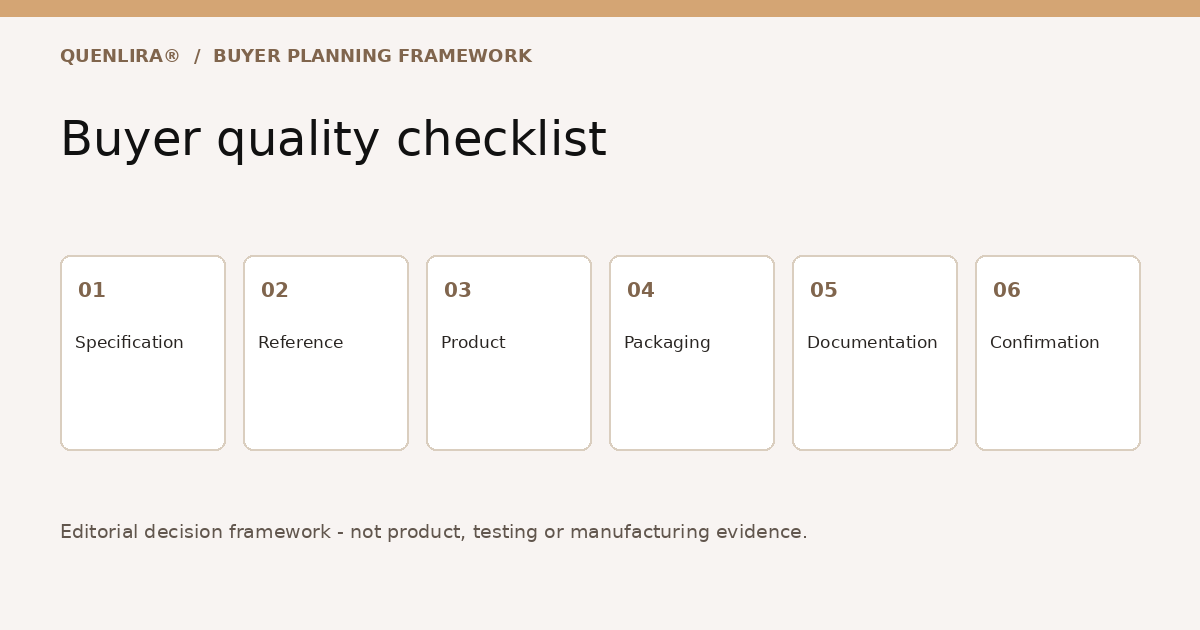
Before bulk confirmation, agree the check scope, inspection stage, acceptance criteria, responsible reviewer and evidence to retain. Distinguish pre-production reference confirmation, any agreed in-process checks and final review before dispatch; these are planning questions, not a claim that inspections have been performed.
| Decision area | Buyer record | Status |
|---|---|---|
| Specification | Identify the current agreed brief and separate proposed changes. | Record: confirmed / open / revision required |
| Reference | Record the approved product and packaging versions and their scope. | Record: confirmed / open / revision required |
| Product | Describe visible observations against the selected reference. | Record: confirmed / open / revision required |
| Configuration | Compare the confirmed pack contents and arrangement. | Record: confirmed / open / revision required |
| Packaging | Check artwork identity, visible presentation and unresolved fit questions. | Record: confirmed / open / revision required |
| Documentation | Retain revisions, approvals and open differences in one accessible record. | Record: confirmed / open / revision required |
| Final confirmation | Resolve outstanding questions before treating the order scope as agreed. | Record: confirmed / open / revision required |
Specification
Identify the current agreed brief and separate proposed changes.
Reference
Record the approved product and packaging versions and their scope.
Product
Describe visible observations against the selected reference.
Configuration
Compare the confirmed pack contents and arrangement.
Packaging
Check artwork identity, visible presentation and unresolved fit questions.
Documentation
Retain revisions, approvals and open differences in one accessible record.
Final confirmation
Resolve outstanding questions before treating the order scope as agreed.
Buyer questions
What does a wholesale buyer need before evaluating lash quality?
Start with a defined specification, an identifiable approved reference and the current packaging and revision records. These establish the scope against which observations can be discussed.
Is 'high quality' enough as a production specification?
No. Translate that preference into agreed requirements and identifiable references. Do not invent numerical limits or inspection standards to fill an undefined brief.
Should packaging be included in the quality review?
Yes. Review the artwork version, product-to-pack fit and visible information against the approved packaging reference, while recording product and packaging decisions separately.
Can buyers assume unlisted tests or certifications have been performed?
No. Ask for relevant evidence for the selected product and claim. A buyer checklist, photograph or sample approval does not establish an unlisted test or certification.
Continue your buying decision
This guide supports buyer decisions. Use the relevant commercial pages for the selected project; requirements remain subject to specification and confirmation.